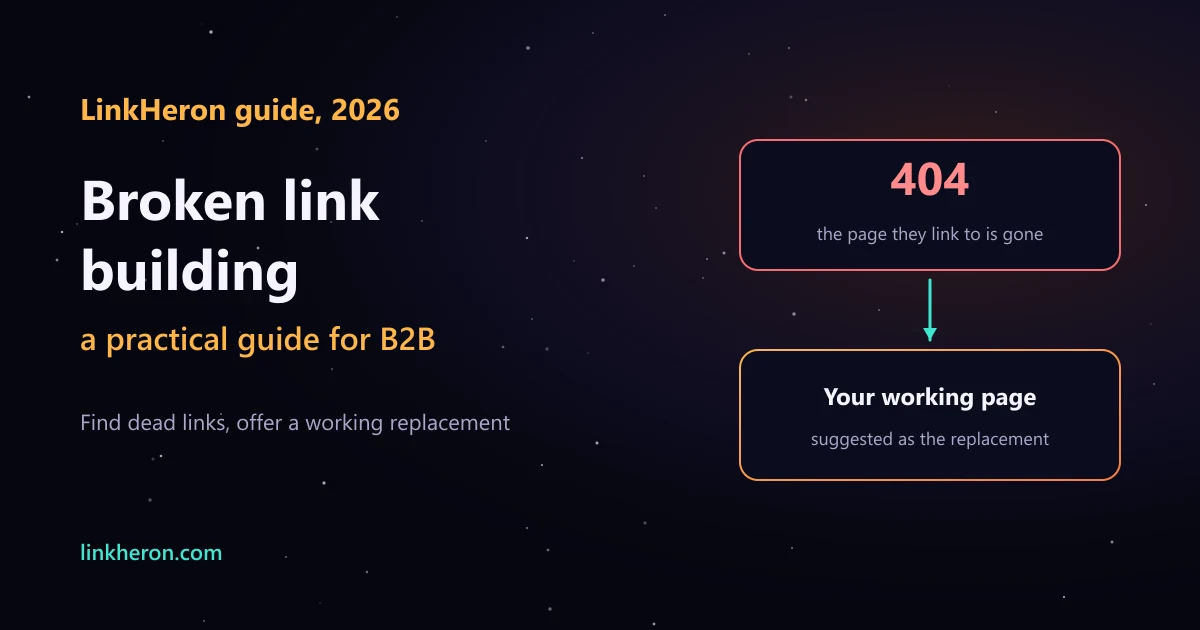
Broken link building is a link building method where you find links on other websites that point to pages that no longer exist, and suggest your own working page as the replacement. The site owner fixes a broken link, their readers get a resource that works, and you earn a relevant backlink.
What is broken link building in SEO?
Broken link building is an outreach tactic built on a simple fact: pages disappear. Companies rebrand, tools shut down, reports get deleted and URLs change without redirects. Every article that linked to those pages now sends readers to an error. When you have a page that covers the same thing, you can tell the editor about the broken link and offer your page instead.
It works because the pitch helps the editor first. You are not asking for a favor, you are reporting a problem on their site and handing them the fix. That makes it one of the asks we compare in our link building outreach guide.
What does the broken link building tactic include?
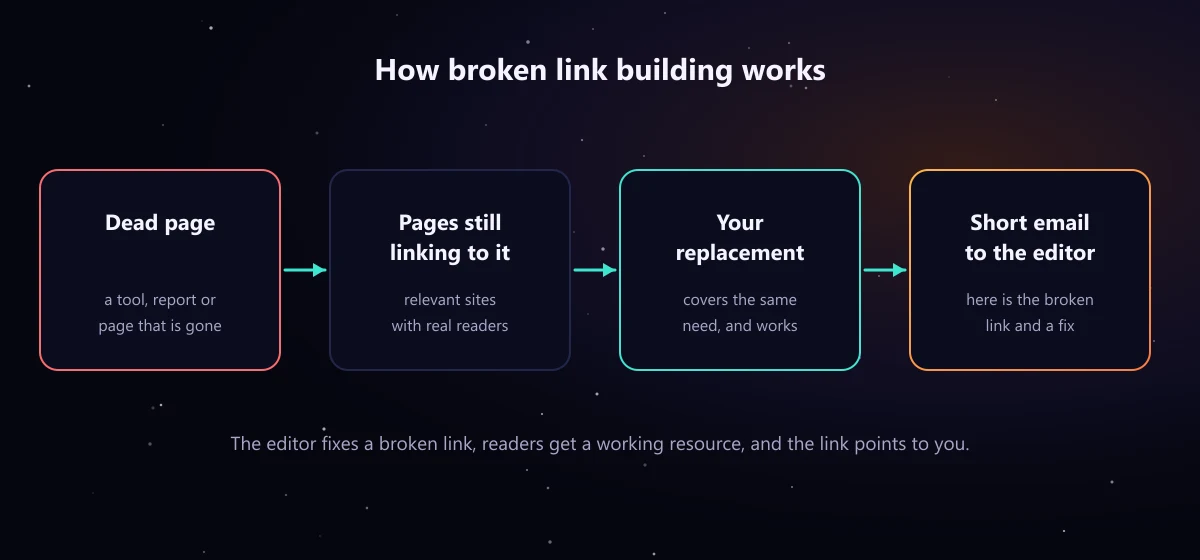
Every broken link building campaign has four parts:
- A dead page that used to be useful and still has links pointing to it.
- The pages linking to it, ideally relevant sites with real readers.
- A replacement: a page of yours that covers the same thing, as well or better.
- Outreach: a short email to each editor that points out the broken link and suggests your page.
Where broken links come from in B2B and SaaS
Most guides send you to generic resource pages. In software and B2B niches, the best dead pages usually come from these events:
- Tools that shut down or were acquired. Comparison posts and "best tools" lists keep linking to products that no longer exist.
- Rebrands and domain changes. When a company moves domain without full redirects, years of links break at once.
- Retired reports and statistics. Annual reports and benchmark pages get deleted, but articles keep citing them as sources.
- Discontinued integrations and features. Help docs and tutorials link to integration pages that were removed.
- Moved documentation and templates. Free templates, checklists and docs move during site redesigns.
If you track your category, you often know about these events before anyone else does. That is your advantage over generic outreach.
How to do broken link building, step by step
1. Start with your own broken pages
Before chasing other sites, check whether your own site has lost links. Pages you deleted or moved may still have backlinks pointing at them. Look for 404 URLs in Search Console's Page indexing report, compare them with the top linked pages in the Links report, and set up 301 redirects to the closest live page. It is the fastest link building win there is, because you do not need anyone's permission.
2. Find dead pages in your niche
Make a list of tools, reports and resources in your category that have disappeared. Then find articles that still link to them. Free ways to search: Google search operators such as "[tool name]" alternatives, intitle:resources [topic] and "[report name]" [year], and the citations in older "best of" lists. Paid backlink tools have broken backlink reports that speed this up a lot; Ahrefs describes that workflow in its own broken link building guide.
3. Check the links on each candidate page
Paste candidate articles into our free dofollow link checker. It lists every link on the page with its anchor text, rel attribute and position, so you can spot outdated targets quickly and see whether a replacement link would be dofollow and inside the content. Open the suspicious ones to confirm they return an error or redirect to an unrelated page.
4. See what the dead page used to say
Look the dead URL up in the Wayback Machine. You need to know what readers expected to find there, because your replacement has to match that intent. A pricing benchmark is not replaced by a product page.
5. Match it or create a better replacement
If you already have a page that covers the topic, update it so it clearly serves the same need. If you do not, decide whether the number of linking sites justifies creating one. A dead page with links from many relevant sites is worth a proper replacement; a dead page with one link is not.
6. Vet each linking site
Not every link is worth chasing. Check that the site has real organic traffic, is still active, writes about your market and does not link out to spam niches. Our link quality standard lists the checks we use before any outreach.
7. Send a short, helpful email
Lead with the problem, name the exact article and the broken link, then offer your page. Keep it short and make it easy to ignore. For example:
The guest post email template generator has a link insertion template you can adapt the same way, with a word count and subject line check.
8. Follow up once and verify
Send one follow up in the same thread about five days later. When an editor updates the link, check it with the dofollow link checker: the link is live, points to the right page and sits in the article.
Broken link building vs guest posting
| Broken link building | Guest posting | |
|---|---|---|
| What you offer | A fix for a broken link | A full article |
| Link placement | Inside an existing, often older article | Inside a new article |
| Effort per link | Research heavy, little writing | Writing heavy, research light |
| Predictability | Lower: depends on finding the right dead pages | Higher: many sites accept contributions |
| Best for | Sites with strong resources, data or tools | Building topical authority and brand reach |
Most B2B link building plans use both. Broken link building earns links in established articles, while guest posts give you steady, predictable placements. Our guide on how to get high quality backlinks covers the other tactics worth combining.
What to expect
Broken link building is slower than it sounds. Many dead pages have few links worth having, some editors never update old posts, and some will remove the link instead of replacing it. It pays off when you have genuinely useful pages and you work a focused list. If you would rather hand off the research and outreach, our SaaS link building and B2B link building services include link insertions on vetted sites, with prices shown before you approve anything.