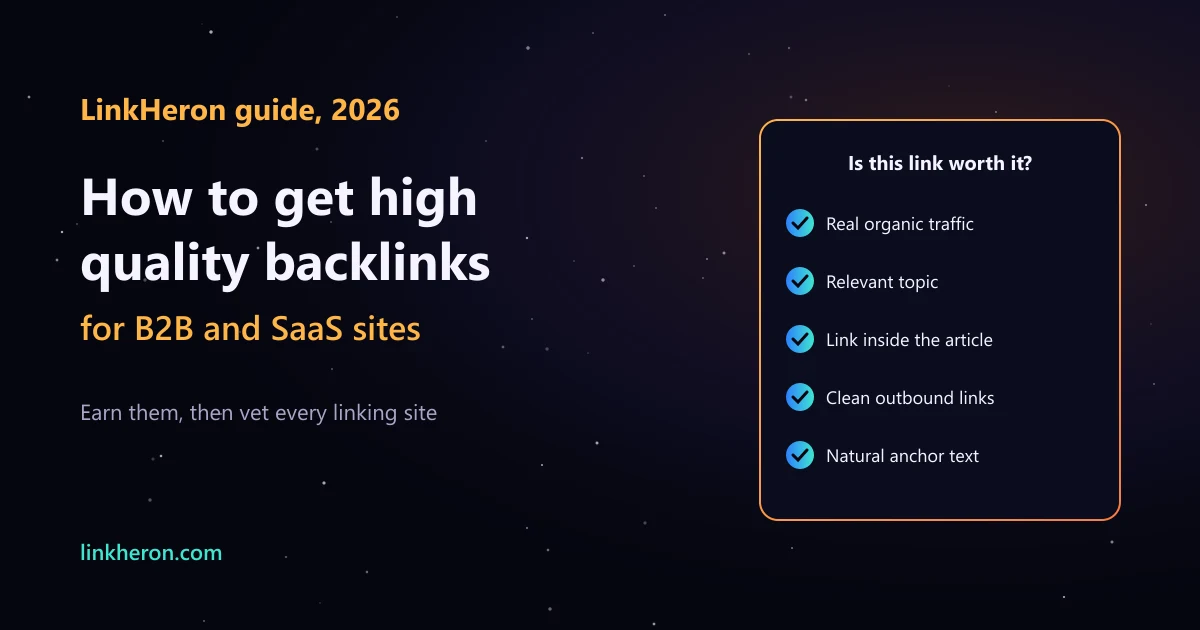
To get high quality backlinks, give relevant sites a real reason to mention you: data they can cite, a product page they can list, an expert answer or an article their readers want. Then check every site before you accept a link, because a link from a blog with no readers does little. This guide covers both halves for B2B and SaaS companies with small teams.
What makes a backlink high quality?
A high quality backlink is a link from a real, relevant site with its own audience, placed inside useful content, with natural anchor text, on a page that stays live. Domain Rating or Domain Authority alone does not make a link good. These are the signals that matter most:
- Real organic traffic. People visit the site from search, so the page carries weight and can send you visitors.
- Topical relevance. The site writes about your market, so the link makes sense to readers and to search engines.
- Editorial placement. The link sits in the body of an article, not in a footer, sidebar or author bio.
- A clean outbound profile. The page does not link out to dozens of unrelated or spammy sites.
- Natural anchor text. Your brand, your URL or a descriptive phrase, not the same exact keyword every time.
Our link quality standard lists the exact thresholds we use for each one.
How to get high quality backlinks: 9 ways that work for B2B
B2B backlinks are harder to earn than consumer links: the audience is narrow, the topics are technical and few people share software pages for fun. These tactics suit that reality. Start with the first three, because they keep paying off once they are set up.
1. Get listed on integration, partner and marketplace pages
If your product connects to other tools, the partner's integration directory or app marketplace usually lists and links to you. Agencies and resellers have partner pages too. These links are relevant by definition, come with your brand name as anchor and are often the quickest high quality backlinks a SaaS company can get.
2. Earn a place on "best of" and comparison lists
Search for "best [your category]" and "[competitor] alternatives", and list the articles that rank. Ask the authors to review your product, with a short, factual summary and a trial account. These pages also feed AI answers: a 2026 study of more than 100,000 AI answers (arXiv 2606.20065) found ranked "best of" lists were the most cited content format, at about 21% of citations.
3. Publish one asset worth citing
Writers link to sources. Original data from your product or customers, a benchmark report, a pricing study or a free calculator gives them something to cite. One strong asset earns links for years; ten thin blog posts rarely earn any. Keep the method and the date on the page so people trust the numbers.
4. Write guest posts for blogs your buyers read
A guest post on a relevant blog with real readers puts your expertise in front of buyers and earns a contextual link. Pick blogs by audience, not by metrics, pitch two or three specific topics and write something better than their average post. Our guest post email template generator writes the pitch, and our guest posting services handle it end to end if you would rather not.
5. Turn unlinked brand mentions into links
Set up alerts for your company and product names. When an article mentions you without a link, send a short thank you and ask the author to link the mention to your site. The writer already chose to talk about you, so the success rate is usually higher than cold outreach.
6. Replace broken and outdated resources
Find pages in your niche that link to tools, studies or guides that no longer exist or are years out of date. If you have a current page that covers the same thing, tell the site owner and offer it as a replacement. You fix a problem for them, which is a better pitch than asking for a favor.
7. Answer journalists and writers as an expert
Reporters and content writers look for quotes from practitioners. Respond quickly to relevant requests with a specific, quotable answer and your title. Not every quote comes with a link, but the ones that do are usually on strong, editorial sites.
8. Go on podcasts and webinars in your niche
Episode pages and webinar recaps link to their guests. B2B podcasts are often small, but their audiences are exactly the buyers you want, and hosts are always looking for guests with real experience.
9. Co-create content with customers and partners
Case studies, joint webinars and co-written guides give both sides a reason to publish and link. A customer that features your product in its own blog post about results is one of the most credible B2B backlinks you can get.
How to check a site before you get a link from it
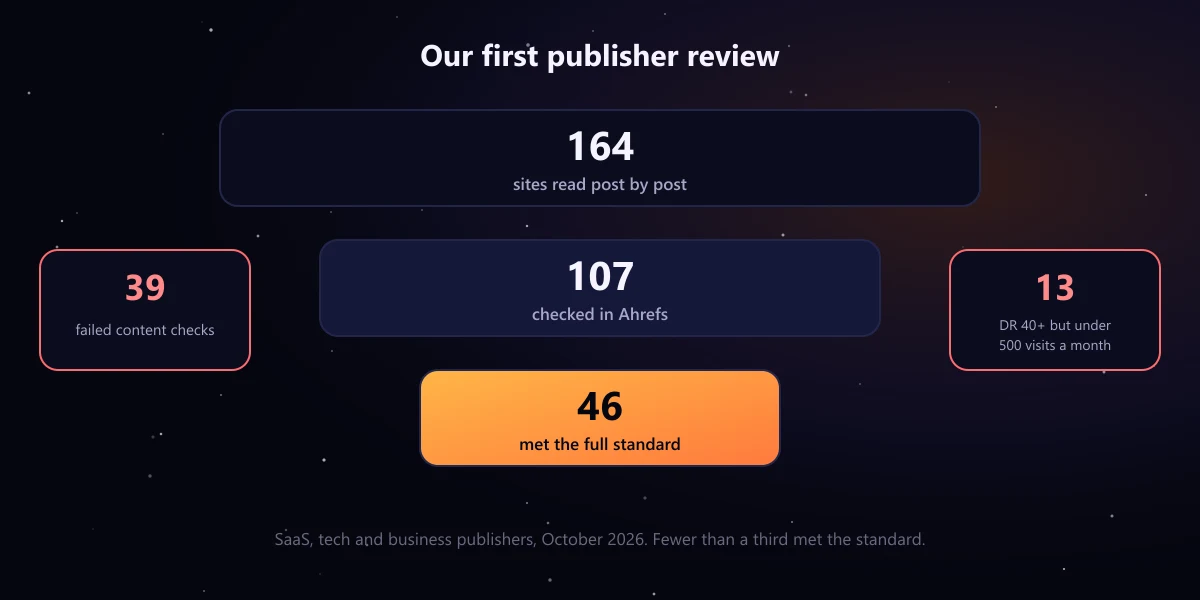
Whatever the tactic, check the linking site first. When we built our own publisher list, we read 164 SaaS, tech and business sites post by post. 39 failed the content checks (inactive, off topic or linking to spam niches). We checked 107 in Ahrefs and only 46 met our full standard. 13 had a Domain Rating of 40 or more but fewer than 500 monthly organic visits: high authority on paper, almost no readers.
A quick checklist you can run on any site in about five minutes:
- Traffic: does it get real organic visits, not just a high DR? Compare the two.
- Activity: is there a new post in the last few months?
- Topic: are most recent posts about your market?
- Outbound links: how many links does a typical post carry, and where do they go? Casino, CBD, adult or essay writing links are a red flag.
- Placement: will your link sit inside the article, with an anchor you agree on?
- Labels: are sponsored posts marked, and how are their links tagged?
How many high quality backlinks do you need?
There is no fixed number. Look at the pages that rank for your target keyword and count how many different relevant sites link to them. That gap, not a generic target, is what you need to close. For a narrow B2B keyword, a handful of strong, relevant links can be enough; for a competitive head term, it can take dozens over many months. Steady progress every month also looks more natural than a burst of links in one week.
Can you get high quality backlinks without guest posting?
Yes. Integration listings, comparison lists, unlinked mentions, broken link replacement, expert quotes, podcasts and co-created content all earn links without writing for someone else's blog. Guest posting is simply the most predictable of these, which is why most B2B link building plans combine it with one or two of the others.
What to avoid
- Private blog networks and link farms: sites built to sell links to anyone. Our vetting rejects them on sight.
- Automated links: comments, forum profiles and mass directory submissions.
- Keyword rich anchors at scale: Google's spam policies name large scale guest posting campaigns with keyword rich anchor text as link spam. Check your mix with the free backlink anchor text checker.
- Paid links passed off as editorial: Google asks that paid links carry rel="sponsored" or nofollow (qualifying outbound links). If a site charges, ask how it labels and tags sponsored content before you decide.
- Metrics only buying: a DR 70 site with no readers is a worse link than a DR 35 site your buyers actually read.
A simple plan for a small B2B team
- Week 1: claim every integration, partner and marketplace listing you qualify for.
- Week 2: list the "best of" and comparison articles in your category and pitch the authors.
- Every month: two or three guest posts or expert contributions on vetted sites, plus unlinked mention follow ups.
- Every quarter: one asset worth citing, and a review of your links in Search Console's Links report.
Budgeting for it? The link building cost calculator compares doing it yourself with hiring help. The publishers we work with quoted between $50 and $150 per post. If you want a team to run the vetting and outreach, see our B2B link building and SaaS link building services, where you approve every publisher, topic and anchor first. Links from cited sources also help with AI search, as our guide on improving brand visibility in AI search explains.