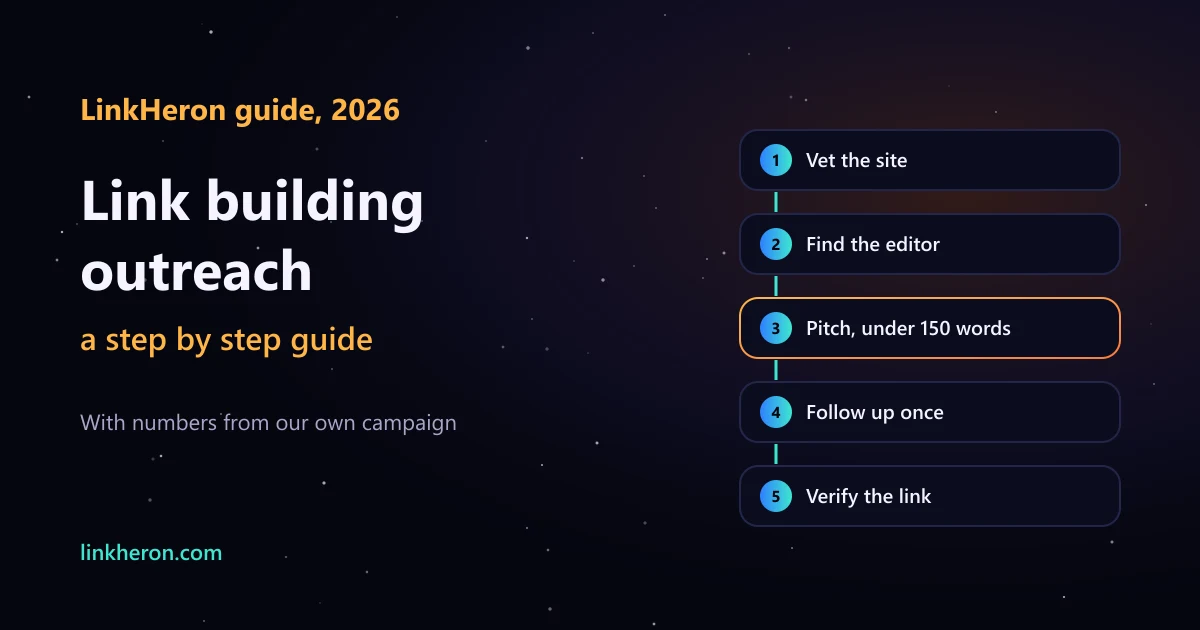
Link building outreach is the work of contacting the people who run relevant websites and giving them a good reason to link to you: an article for their readers, a better resource for an existing post, or a fix for a broken link. It works when the list is small and vetted, the email is short and specific, and you follow up once.
What is outreach link building?
Outreach link building means earning backlinks by contacting site owners, editors and writers directly, usually by email, instead of waiting for links to happen. Every outreach email makes one ask: publish a guest post, add your page to an existing article, list you on a resource page, replace a broken link or link an existing mention of your brand.
It is not the same as buying links in bulk. Some publishers charge for sponsored posts, and that is a normal part of the market, but Google's spam policies treat paid links that pass ranking credit, and large scale guest posting with keyword rich anchors, as link spam. Good outreach is selective and transparent about what is paid.
Before you send: set up the mailbox
Most outreach guides start with templates. Start with deliverability instead, because the best pitch does nothing in a spam folder.
- Send from your own domain, from a real person's mailbox, not a free webmail address or a no reply sender.
- Set up SPF, DKIM and DMARC as Google's email sender guidelines describe, and check that test emails land in the inbox.
- Warm up a new domain with normal conversations for a week or two before any cold email.
- Keep volume low and spaced out. A few dozen personal emails a day beats hundreds of identical ones.
- Send plain text with one or two links, no images and no tracking pixels.
Step 1: Build and vet a target list
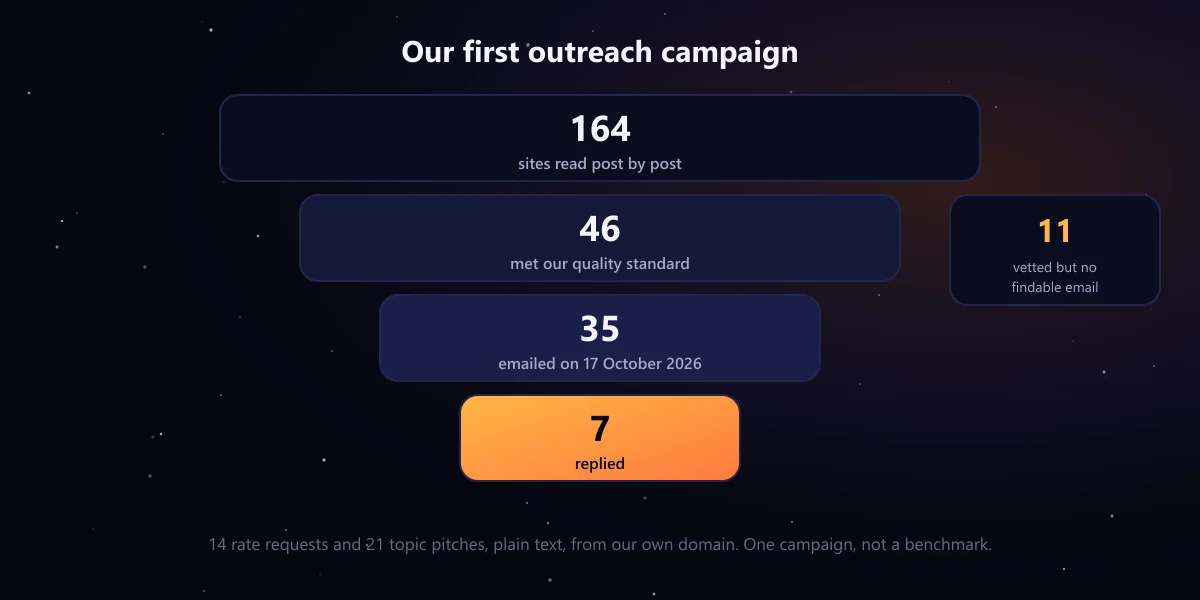
List sites your buyers actually read: industry blogs, newsletters with a website, software review and comparison sites, partner and integration pages. Then vet every one before you write a word. When we built our first publisher list, we read 164 SaaS, tech and business sites post by post and only 46 met our link quality standard. Outreach to the other 118 would have been wasted effort or worse.
The quick checks: real organic traffic (not just a high Domain Rating), a post in the last few months, mostly on topic content, and a reasonable number of outbound links per post.
Step 2: Find the right person
Pitch the editor or the author who covers your topic, not a generic info@ address. Look at the author byline, the "write for us" or contribute page, the about or team page, and the person's LinkedIn profile. Some sites have no findable email at all: in our first campaign, 11 of the 46 vetted publishers had none. Those have to be reached by hand, through a contact form or a social profile.
Step 3: Choose the right ask
Match the ask to the site. One email, one ask.
Guest post
For blogs that publish contributor articles. Pitch two or three specific topics that fit their readers. It is the most predictable type of outreach link.
Link insertion
For an existing article that already ranks, where your page adds something real. Name the article and say what your page adds. Many sites charge for these edits.
Resource page
For curated lists of tools or guides in your niche. Explain in one line why your resource belongs on the list.
Broken link replacement
For pages that link to tools or studies that no longer exist. Point out the broken link first, then offer your page as a replacement.
Unlinked brand mention
For articles that already mention your company without a link. A short thank you and a request to link the mention usually has the best success rate.
Expert quote
For writers and journalists looking for practitioner input. Answer fast, be specific and quotable, and include your title.
Step 4: Write a short, specific pitch
Keep the first email under 150 words. Open with the person's name and one of their articles you actually read, say who you are in one line, make the ask with specifics (three topic titles, or the exact article and section), and end with one easy question. Our free guest post email template generator builds pitches, rate requests, link insertion requests and follow ups from your own details, with a word count and a subject line check.
Step 5: Follow up once
Send one follow up in the same thread about five days later. Keep it shorter than the first email, repeat your strongest idea and make it easy to say no. If there is still no answer, move on. Repeated reminders get reported as spam, which hurts every future email from your domain.
Step 6: Track replies and verify every placement
Measure the numbers that matter, per campaign:
- Reply rate: replies divided by emails delivered.
- Placement rate: live links divided by emails sent.
- Cost per live link: fees plus writing plus your time.
- Links still live after 3 and 6 months.
When a link goes live, check it the same day: is it on the page, with the agreed anchor, dofollow or labelled as agreed, inside the article and on an indexable page? The free dofollow link checker verifies up to 10 placements at once, and the backlink anchor text checker shows whether your overall anchor mix stays natural.
What our first outreach campaign looked like
On 17 October 2026 we emailed 35 of our 46 vetted publishers from our own domain mailbox: 14 emails asked for sponsored post rates and 21 pitched specific topics. We sent them one at a time with a few minutes between each, and got 7 replies in the first days.
What the replies taught us:
- Prices vary wildly. Quotes ranged from $50 to $2,500 per post for sites we had rated similarly. We turned down the two most expensive.
- Asking about ongoing work changes the price. One publisher cut its rate by a third when we asked about regular orders instead of a single post.
- Free editorial still exists. One site offered to publish for free if the topic fitted its niche, and asked for a topic pitch first.
- Many replies are questions. Budget, topic, payment method, invoice details. Answer fast and completely; slow answers lose the slot.
Seven replies from 35 emails is one small sample, not a reply rate you should expect. It does show that short, plain, personal emails to a vetted list get answered.
How to scale link building outreach without spamming
- Grow the list, not the volume per day. More vetted sites, sent at the same steady pace.
- Keep a simple CRM. One row per site: contact, status, last email, price, live URL. Never email the same person twice in a sequence by mistake.
- Reuse what works, personalise what matters. Templates for structure, a real first line and real topics for every site.
- Add a second mailbox on a separate domain if volume grows, so your main domain's reputation stays clean.
- Hand off the repetitive parts. Vetting, writing and follow ups take the most time; that is the part our guest posting services and white label link building cover for teams and agencies.
For which tactics to combine with outreach, read our guide on how to get high quality backlinks.