What is a guest post email template?
A guest post email template is a ready made outreach email you adapt for each blog: a pitch asking to write an article, a request for a sponsored post rate, or a follow up. The template gives you the structure. The personal parts, the editor's name, an article of theirs you read and topics that fit their readers, are what get a reply.
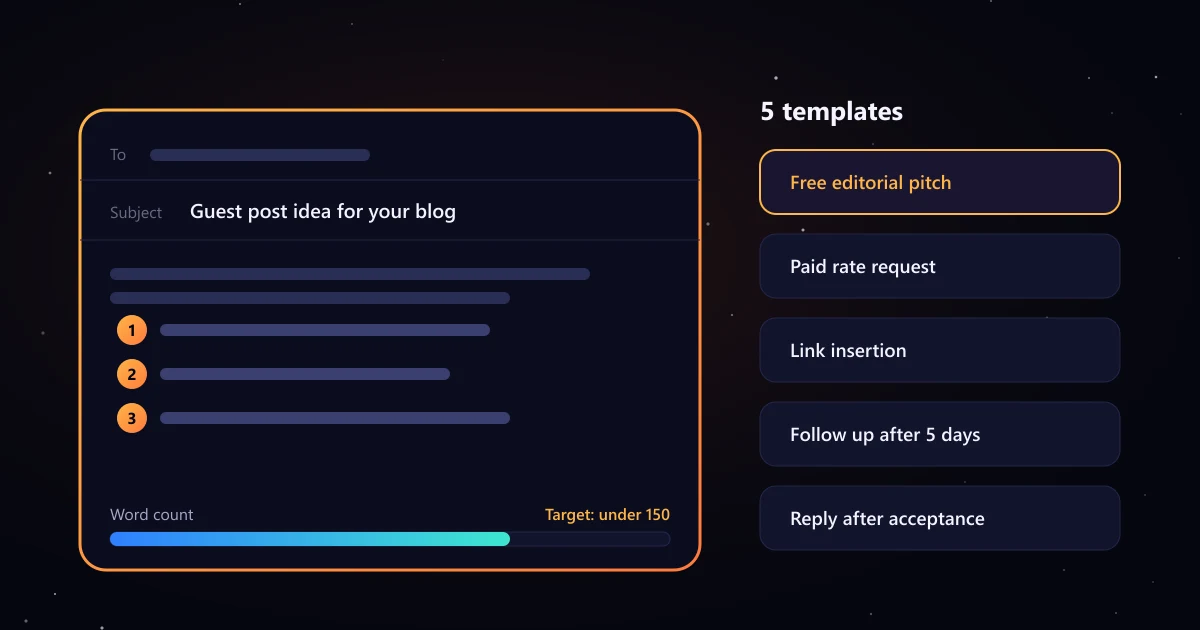
How to use the guest post email generator
- Add your details. Your name, your site and the blog you are pitching. Add the editor's first name if you found it; otherwise the email opens with "Hi there".
- Name an article you read. One recent post from their blog. It shows the email was written for them, so read it first.
- Write three topic ideas. Specific titles that fit their readers and are not already covered on their blog.
- Pick a template. Free pitch, paid rate request, link insertion, follow up or reply after acceptance.
- Edit and check. Change any line you like. Keep the word count under 150 and fix anything the subject line check flags.
- Copy and send from your own mailbox as plain text.
5 guest post email templates for every stage of outreach
Here is each template filled with the example inputs. In the generator above, they update as you type.
Free editorial pitch
Use it for blogs that publish contributor articles without a fee. Lead with an article of theirs you read, give three specific ideas, and offer an outline instead of a finished draft.
Paid guest post rate request
Use it for sites that sell sponsored or guest posts. Ask everything you need in one email, so the first reply gives you a price, the link policy and the payment method.
Link insertion request
Use it when an existing article already ranks and your page adds something real to it. Point to the exact article and say what your page adds for their readers.
Follow up after 5 days
Send it once, in the same thread, about five days after the first email. Keep it shorter than the original and make saying no easy.
Reply after acceptance
Send it the day they say yes. Confirm the topic and settle word count, links, images, bio and any invoice details before you write, so the draft does not come back.
What makes a guest post outreach email get a reply
Editors and site owners get many pitches a week, and most look the same. The ones that get answered make it easy to say yes quickly. In our own outreach, we emailed 35 publishers on 17 October 2026 with short, plain text emails built like these templates and got 7 replies. That is one small batch, not a benchmark, but it shaped the rules below.
- Proof you read the blog. Name one real article. Generic praise like "I love your content" reads as a mass email.
- Specific topics. Three titles that fit their readers beat "I can write on any topic".
- One clear question. "Want an outline for one of these?" is easier to answer than an open request.
- Short and plain. Under 150 words, no images, no attachments, one or two links at most.
- A real sender. Send from a mailbox on your own domain, set up with SPF, DKIM and DMARC as Google's email sender guidelines describe, and keep daily volume small.
How long should a guest post pitch be?
Aim for under 150 words. That is enough for a greeting, one line about who you are, three topic ideas and a closing question. Everything else, outlines, writing samples and links to past articles, can follow once the editor replies. The generator counts words as you edit and turns amber above 150.
When to follow up on a guest post request
Follow up once, about five days after your first email, in the same thread so the editor sees the original pitch. Keep it to a few lines, repeat your strongest idea and say that a quick no is fine. If there is still no answer, stop and move on: repeated reminders get marked as spam, which hurts every future email from your domain.
Paid guest posts, link insertions and Google's rules
Many blogs charge for sponsored posts or for adding a link to an existing article. Asking for a rate is normal. What matters is how the link is treated: Google's spam policies list buying links that pass ranking credit as link spam, and its guide to qualifying outbound links asks sites to mark paid links with rel="sponsored". That is why the rate request template asks how sponsored links are marked. Ask before you pay, and judge the site on its readers and relevance, not on the link alone.
Before you pitch any site, check that it has real organic traffic, publishes on your topic and is not a site that posts anything for a fee. Our link quality standard lists the checks we use and the red flags that make us reject a publisher.
Doing outreach yourself, or handing it off
Templates save writing time, but most of the work in guest posting is finding the right blogs, vetting them, writing the articles and following up. If you want to see what that costs in time and money, try the link building cost calculator. If you would rather not run outreach at all, our guest posting services cover publisher vetting, writing and placement for SaaS and B2B companies.