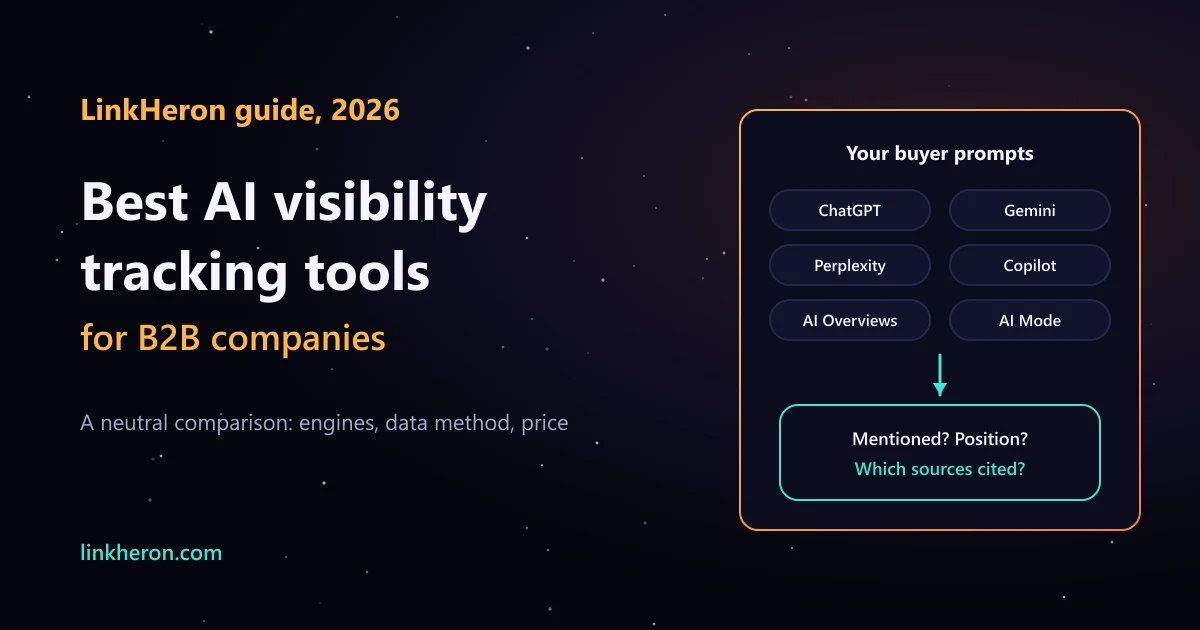
The best AI visibility tracking tool for a B2B company is the one that checks the AI engines your buyers use, runs enough of your real buying questions, and shows which sources the answers cite. Below we compare nine popular tools on exactly those points, using what each vendor publishes, with prices checked in October 2026.
How we wrote this: LinkHeron does not sell a tracking tool and has no affiliate deal with any vendor below. We did not run a hands on test of every tool. Engines, data methods and prices come from each vendor's own pages, linked in every row, so you can check them yourself. Prices change often, so confirm on the vendor's site before you buy.
What does an AI visibility tracking tool do?
An AI visibility tracking tool sends a fixed set of prompts, the questions your buyers ask, to AI engines such as ChatGPT, Gemini, Perplexity and Google AI Overviews on a schedule. It records whether your brand is mentioned, where it appears, how it is described and which web pages the answer cites, then compares you with competitors over time.
Most tools report some version of these metrics:
- Visibility or mention rate: the share of answers that name your brand.
- Position: where you appear when the answer lists several options.
- Share of voice: your mentions compared with competitors for the same prompts.
- Citations and sources: the pages the AI engine used, which tell you where to get mentioned.
- Sentiment and accuracy: whether the description of your product is positive and correct.
AI visibility tools compared: engines, data and price
Checked on each vendor's site in October 2026. "Engines" lists what the vendor says it covers; some engines are only on higher plans.
| Tool | AI engines covered | How data is collected (as published) | Starting price |
|---|---|---|---|
| Profound | Trial: ChatGPT, Gemini, AI Overviews. Enterprise: up to 9, adding Perplexity, AI Mode, Copilot, Claude, DeepSeek and Exa | Not detailed on the pricing page. Runs structured prompts across platforms; its Prompt Volumes feature is described as built on real user conversations | Free 7 day trial (50 prompts a day); Enterprise is custom priced |
| Semrush AI Visibility Toolkit | ChatGPT, Gemini, AI Overviews, AI Mode; Perplexity in the Brand Performance report | Responses captured from real requests, not LLM APIs. Prompt database sourced from AI clickstream data and Google keyword data | $99 a month for the toolkit; also included in the SEO + AI Search Starter plan at $199 a month |
| SE Visible (SE Ranking) | ChatGPT, Gemini, AI Mode, AI Overviews | Real answers collected through a browser and the platform interface, not simulated or API based; refreshed daily | From $99 a month (200 prompts), $79 a month billed annually; 10 day free trial |
| Otterly.AI | ChatGPT, AI Overviews, Perplexity, Copilot; Gemini, AI Mode and Claude as add ons | Not detailed on the pricing page; describes analyzing AI search platforms directly | Lite $29 a month (15 prompts) |
| Peec AI | Choose 3 on Starter from ChatGPT, AI Mode, AI Overviews, Copilot, Gemini and Naver AI; up to 13 models on Enterprise | Scrapes the platforms' web interfaces instead of using APIs and runs prompts daily, per its documentation | Starter $95 a month (50 prompts, 3 models, unlimited users) |
| Ahrefs Brand Radar | AI Overviews, AI Mode, ChatGPT, Perplexity, Gemini, Copilot; Claude in Custom Prompts | AI Visibility Index: prompts modeled from real searches in Ahrefs' keyword database, run on each platform. Custom Prompts: questions you define | Custom Prompts from $50 a month; AI Visibility Index from $199 a month ($699 for all models). Paid Ahrefs plans include a small daily Custom Prompts quota |
| Surfer AI Tracker | ChatGPT, Gemini, Perplexity, AI Overviews, AI Mode | Scrapes real answers from each engine's interface, runs several queries per model each day and averages them | From $82 a month billed yearly; its FAQ points to the $99 Standard plan for ChatGPT tracking |
| Scrunch | ChatGPT, Claude, Gemini, Perplexity, AI Mode, AI Overviews, Meta | Not detailed on the pricing page; also monitors AI agent traffic to your site | Starter $300 a month, or $250 a month billed annually (350 custom prompts) |
| AthenaHQ | Free plan: ChatGPT, Perplexity, AI Overviews, Gemini, Copilot. Starter: 11 models, adding AI Mode, Claude, Grok, DeepSeek, Meta AI and Mistral | Not detailed on the pricing page; credit based, where 1 credit equals 1 AI response | Free Essential plan (300 credits); Starter $295 a month (3,600 credits) |
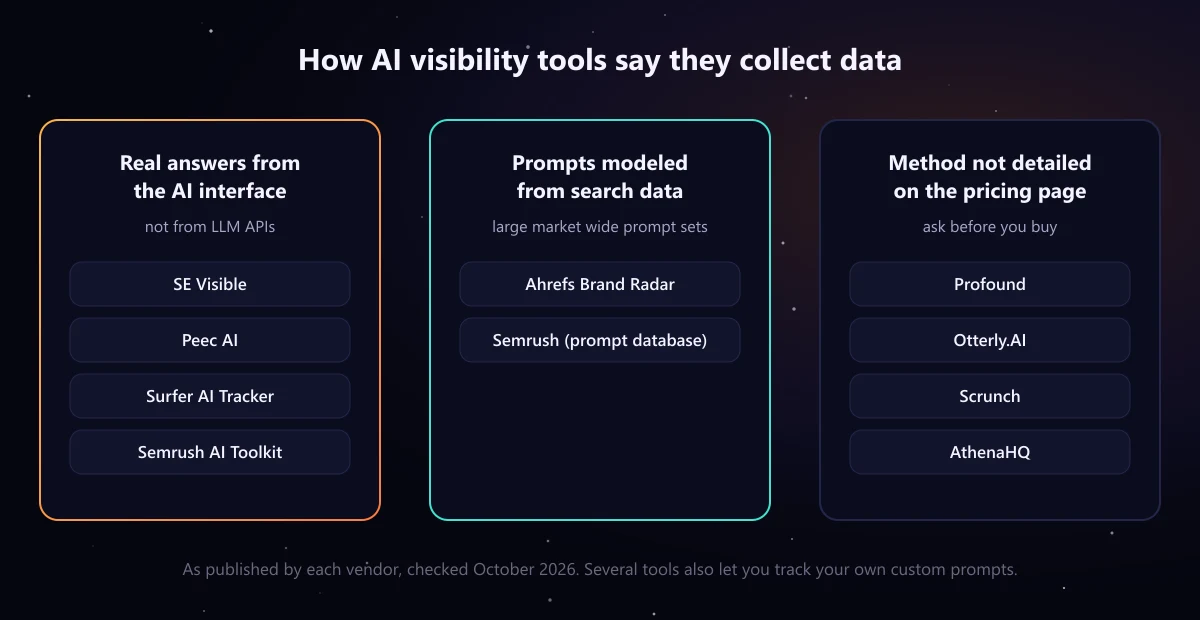
Measured answers vs modeled data: why the method matters
AI answers change from one run to the next and can differ between the app a person uses and the API a developer calls. That is why the collection method matters more than it looks. Tools that capture answers from the real interface show what a buyer would actually see. Tools that build large prompt sets from search keyword data are good for market wide benchmarks, but those prompts are modeled from searches, not taken from your buyers' own questions.
Neither is wrong. For a B2B company with a narrow market, the most useful setup is usually a short list of your own buying prompts, tracked from the real interface, plus a market view if you can afford it. When a vendor does not publish its method, ask before you sign up.
The 9 best AI visibility tracking tools
1. Profound
Profound is built for enterprise teams: the only self serve option on its pricing page is a short trial, and the full engine list sits on the custom plan. It also offers an AI Marketer agent for research and content work on top of tracking.
- Best for: Larger B2B brands that want the widest engine coverage and a sales led setup.
- Engines: Trial: ChatGPT, Gemini, AI Overviews. Enterprise: up to 9, adding Perplexity, AI Mode, Copilot, Claude, DeepSeek and Exa.
- Starting price: Free 7 day trial (50 prompts a day); Enterprise is custom priced. Source: Profound pricing page.
2. Semrush AI Visibility Toolkit
The toolkit combines a large prompt database (for market wide visibility and competitor research) with daily tracking of the prompts you choose. Semrush publishes where its data comes from, which makes the numbers easier to judge.
- Best for: Teams already on Semrush who want AI data next to their keyword and ranking data.
- Engines: ChatGPT, Gemini, AI Overviews, AI Mode; Perplexity in the Brand Performance report.
- Starting price: $99 a month for the toolkit; also included in the SEO + AI Search Starter plan at $199 a month. Source: Semrush AI Visibility Toolkit data methodology page.
3. SE Visible (SE Ranking)
SE Visible is SE Ranking's standalone AI visibility product. Its entry plan includes 200 prompts and 3 projects, which covers a focused B2B prompt list with room for competitors.
- Best for: Small and mid size teams that want a dedicated tracker with a clear prompt allowance.
- Engines: ChatGPT, Gemini, AI Mode, AI Overviews.
- Starting price: From $99 a month (200 prompts), $79 a month billed annually; 10 day free trial. Source: SE Visible (SE Ranking) product page.
4. Otterly.AI
Otterly.AI has the lowest paid entry point in this list. Fifteen prompts is enough to watch your most important buying questions, and higher plans add API and MCP access.
- Best for: Solo marketers and small teams testing AI tracking on a small budget.
- Engines: ChatGPT, AI Overviews, Perplexity, Copilot; Gemini, AI Mode and Claude as add ons.
- Starting price: Lite $29 a month (15 prompts). Source: Otterly.AI pricing page.
5. Peec AI
Peec AI puts a lot of weight on sources: which domains and URLs AI tools retrieved, and gap reports for sources that name competitors but not you. Its documentation explains the interface scraping method.
- Best for: SEO and content teams that want source and citation analysis, not just mention counts.
- Engines: Choose 3 on Starter from ChatGPT, AI Mode, AI Overviews, Copilot, Gemini and Naver AI; up to 13 models on Enterprise.
- Starting price: Starter $95 a month (50 prompts, 3 models, unlimited users). Source: Peec AI pricing page.
6. Ahrefs Brand Radar
Brand Radar is strongest at the market view: how often any brand appears across a very large prompt set derived from search data. Custom Prompts covers the specific buyer questions you care about.
- Best for: Ahrefs users and teams that want market wide benchmarks against competitors.
- Engines: AI Overviews, AI Mode, ChatGPT, Perplexity, Gemini, Copilot; Claude in Custom Prompts.
- Starting price: Custom Prompts from $50 a month; AI Visibility Index from $199 a month ($699 for all models). Paid Ahrefs plans include a small daily Custom Prompts quota. Source: Ahrefs Brand Radar product page.
7. Surfer AI Tracker
Surfer's tracker sits next to its content editor, so the same team can see a visibility gap and work on the page. Check which plan covers the engines you need, because the page ties some engines to higher plans.
- Best for: Content teams already using Surfer for writing and on page work.
- Engines: ChatGPT, Gemini, Perplexity, AI Overviews, AI Mode.
- Starting price: From $82 a month billed yearly; its FAQ points to the $99 Standard plan for ChatGPT tracking. Source: Surfer AI Tracker product page.
8. Scrunch
Scrunch includes a large prompt allowance at entry level and tracks how AI agents visit your site, which helps connect visibility to traffic.
- Best for: Mid size B2B teams that want broad engine coverage and agent traffic data in one plan.
- Engines: ChatGPT, Claude, Gemini, Perplexity, AI Mode, AI Overviews, Meta.
- Starting price: Starter $300 a month, or $250 a month billed annually (350 custom prompts). Source: Scrunch pricing page.
9. AthenaHQ
AthenaHQ prices by credits rather than prompts, which makes the cost easy to map to how many answers you check. It connects to GA4 and Search Console.
- Best for: Teams that want to start free and pay by volume of answers checked.
- Engines: Free plan: ChatGPT, Perplexity, AI Overviews, Gemini, Copilot. Starter: 11 models, adding AI Mode, Claude, Grok, DeepSeek, Meta AI and Mistral.
- Starting price: Free Essential plan (300 credits); Starter $295 a month (3,600 credits). Source: AthenaHQ pricing page.
Free ways to track AI search visibility
You can learn a lot before paying for a tool. These three methods cost nothing and also help you write a better prompt list for a paid tool later.
1. Keep a prompt log
Write 15 to 25 questions your buyers ask before they shortlist a vendor, such as "best [category] for [industry]" or "[competitor] alternatives". Once a month, ask each one in ChatGPT, Perplexity, Gemini and Google, in a logged out or private window, and record in a sheet: date, engine, whether you are named, your position, the competitors named and the cited sources. It is slow, but the sources column alone shows you where to focus.
2. Check Google Search Console
Google says clicks and impressions from AI Overviews and AI Mode are counted in the Search Console Performance report, under the Web search type, as part of normal search traffic (Google Search Central: AI features and your website). There is no separate AI filter, but rising impressions on long, question style queries are a useful signal.
3. Track AI referrals in GA4
Create a custom channel group in Google Analytics 4 (Google's guide to custom channel groups) with a channel for AI assistants, matching sources such as chatgpt.com, perplexity.ai, gemini.google.com, copilot.microsoft.com and claude.ai. Some AI traffic arrives without a referrer, so treat the number as a minimum, not a total.
How to choose an AI visibility tool for a B2B company
- Start with your prompts, not the tool. Write the 20 to 50 questions your buyers really ask. If a plan cannot hold them with a few competitors, it is too small.
- Match the engines to your buyers. Most B2B research touches ChatGPT and Google (AI Overviews and AI Mode). Add Perplexity, Copilot or Claude if your buyers use them.
- Check the data method. Prefer published methods. Ask vendors who do not publish one.
- Insist on source data. Mention counts tell you where you stand. Cited URLs tell you what to do next.
- Look at seats, projects and exports. Agencies and multi product companies need projects, API or CSV export and client friendly reports.
- Run a trial on your own prompts. Several tools offer free plans or trials. Compare two side by side for a couple of weeks before committing.
What to do with AI visibility data
Tracking only tells you where you stand. Visibility changes when the pages AI engines read start to mention you accurately. A 2026 study of more than 100,000 AI answers (arXiv 2606.20065) found that ranked "best of" lists were the most cited content format, at about 21% of citations, so the sources report in your tool is effectively a to do list.
- Get onto the cited pages. Ask the publishers of cited roundups, reviews and comparisons to include you with an accurate entry.
- Fix wrong facts at the source. If answers describe your pricing or features wrongly, find which pages they cite and correct your own pages and listings first.
- Make your own pages easy to quote. Plain, factual paragraphs, clear headings and crawlable pages. Our guide to LLM SEO covers this, and the llms.txt generator helps AI tools read your site.
- Re-test the same prompts monthly and track the trend, not single answers.
For the full process from prompt testing to source mapping, read how to improve brand visibility in AI search engines. If you would rather hand off the source work, our generative engine optimization services find the pages AI tools cite for your buyers' questions and work on getting your brand onto them, with prices shown before you approve anything.