To improve brand visibility in AI search engines, find the questions your buyers ask ChatGPT, Perplexity and Google AI Overviews, see which pages those answers are built from, and get your brand accurately described on those pages and on your own site. Then test again every month. The rest of this guide shows how, step by step, for SaaS and B2B teams.
What brand visibility in AI search engines means
Brand visibility in AI search is how often an AI tool names your brand when someone asks a question you should be part of, where it places you in the answer, which sources it cites, and whether it describes you correctly. Four things are worth separating:
- Mentioned: your brand name appears in the answer.
- Recommended: you appear as one of the options the tool suggests, ideally near the top.
- Cited: a page about you, or by you, is listed as a source.
- Accurate: what the answer says about your product, pricing and audience is true.
A brand can be mentioned and still lose the deal, for example when the answer recommends three competitors first or repeats outdated pricing.
How AI search engines decide which brands to mention
When you ask an AI tool for "the best project management software for agencies", it usually searches the web, reads a set of pages, and writes an answer from them. The brands it names are mostly the brands those pages name. That makes the sources the real battleground.
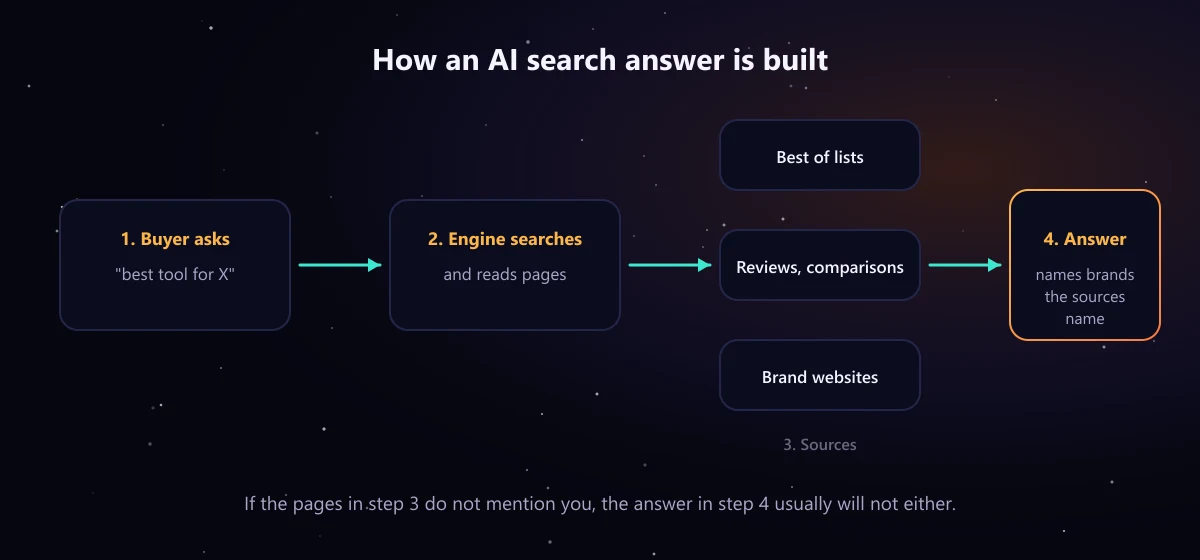
A 2026 study of more than 100,000 AI answers across 100+ brands (arXiv 2606.20065) found three things that matter for anyone who is not already a household name:
- Global household brands appeared in about 73% of relevant answers on the first test, established mid-market brands in 44%, and niche or small brands in just 11%.
- When engines cited sources, about 78% went to corporate websites. Your own site still matters.
- Ranked "best of" listicles were the single most cited content format, at about 21% of all citations.
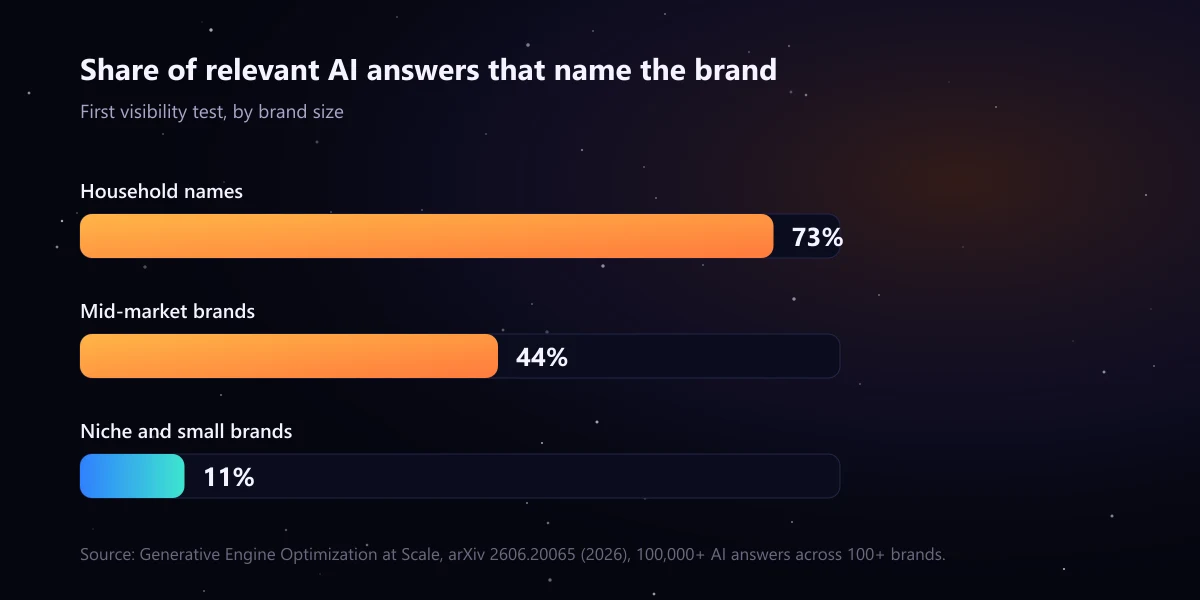
For a smaller SaaS or B2B brand, the takeaway is simple: you start far behind, your own pages need to be easy to quote, and the third party lists in your category carry a lot of weight.
8 steps to improve brand visibility in AI search engines
1. Write down the questions your buyers actually ask
Start with 15 to 25 prompts. Cover the types of questions that come right before a shortlist:
- Best of: "best [category] software for [audience]"
- Alternatives: "[biggest competitor] alternatives"
- Comparison: "[you] vs [competitor]"
- Use case: "[category] tool that integrates with [tool your buyers use]"
- Problem: the pain your product removes, in your buyer's words
Ask your sales team which questions prospects bring to calls. Those phrases are usually closer to real prompts than your keyword list.
2. Run a baseline test in ChatGPT, Perplexity and Google AI Overviews
Run every prompt in each engine from a private or logged out window, so your own history does not shape the answer. For each answer, record whether you are named, your position, which competitors are named, and every cited URL. A spreadsheet is enough. Engines often cite different sources for the same question, so test each one separately.
3. Map the pages behind each answer
Group the cited URLs and count how often each page appears. Within a few dozen prompts, a short list usually rises to the top: a handful of roundups, comparison posts, review sites and industry articles. These are the pages that decide who gets recommended in your category, and they are your priority list.
4. Get onto the "best of" lists and comparisons that are already cited
For each priority page, check whether you are listed, how you are described, and who you are listed next to. Then work on inclusion: contact the editor with a useful, honest entry (who the product is for, what it does differently, current pricing) rather than a sales pitch. Prioritise pages on real sites with real readers. A list on a site nobody visits is less likely to be cited, and it does nothing for your human buyers either. When we checked 107 SaaS and B2B blogs in Ahrefs, 13 had a Domain Rating of 40 or more but fewer than 500 monthly organic visitors, which is why we look at traffic as well as authority. Our full checklist is on our publisher quality standard page.
5. Make your own site easy to quote
Because most citations still go to brand websites, your pages should answer questions in a form an AI tool can lift directly:
- One clear sentence on your homepage that says what you are, for whom: "[Brand] is a [category] for [audience] that [main outcome]."
- Honest comparison and alternatives pages for your main competitors.
- A pricing page with real numbers, or a clear explanation of how pricing works.
- Short, direct answers under question style headings, plus an FAQ section.
- Structured data (Organization, Product or Service, FAQPage) that matches what the page says.
6. Optimize your website for ChatGPT and Perplexity crawlers
AI engines can only use pages they can reach. Check these technical basics:
- robots.txt: do not block the search crawlers you want answers from, such as OAI-SearchBot (ChatGPT search) and PerplexityBot. Blocking GPTBot only affects OpenAI model training, not ChatGPT search.
- Google: AI Overviews use Google's normal index, so standard SEO health applies. Google-Extended controls Gemini model training, not AI Overviews.
- Bing: verify your site in Bing Webmaster Tools and submit your sitemap. Several AI assistants draw on search indexes beyond Google, and IndexNow helps new pages get picked up faster.
- Rendering: make sure key content is in the HTML, not only loaded by JavaScript after the page opens.
- llms.txt: a short markdown summary of your site for AI tools. It is a proposed standard and no major engine has confirmed using it, so treat it as a low cost extra, not a fix. Ours is here as an example.
7. Earn consistent mentions on sites your buyers read
Beyond the top cited pages, AI tools pick up patterns across the web. If industry blogs, partner pages and review sites describe you the same way (same category, same audience, same strengths), engines are more likely to repeat that description. Guest articles, expert quotes, integration partner pages and customer stories all help, as long as they appear on relevant sites with an actual audience.
8. Re-test every month and track the trend
AI answers change as engines refresh their sources, so one test proves little. Re-run the same prompt set monthly, in the same way, and compare. Expect changes to show up over weeks or months, not days, and do not trust anyone who guarantees a citation by a date.
AI search visibility metrics and KPIs to track
Keep it to a few numbers you can measure the same way every month:
| Metric | How to calculate it | Why it matters |
|---|---|---|
| Share of answers | Answers that name you divided by all answers tested | Your headline visibility number, per engine |
| Average position | Your average rank among the brands named, when you appear | Being named fifth is not the same as being named first |
| Share of voice | Your mentions divided by all brand mentions in the set | Shows progress against named competitors |
| Citation share | Cited URLs that are your pages or pages that list you, divided by all cited URLs | Tells you whether the sources work for you |
| Accuracy rate | Answers that describe you correctly divided by answers that name you | Wrong pricing or audience costs deals |
| AI referral traffic | GA4 sessions from sources such as chatgpt.com, perplexity.ai, gemini.google.com and copilot.microsoft.com | Connects visibility to visits and leads |
What not to do
- Post fake reviews or fake forum answers about your brand. It breaks platform rules and can damage how you are described.
- Stuff pages with keywords or prompt text aimed at AI tools. Clear answers work better than tricks.
- Buy placements on sites that publish anything for a fee and have no readers.
- Pay anyone who promises guaranteed AI citations or "getting into the training data". Nobody controls that.
A simple 30 day plan
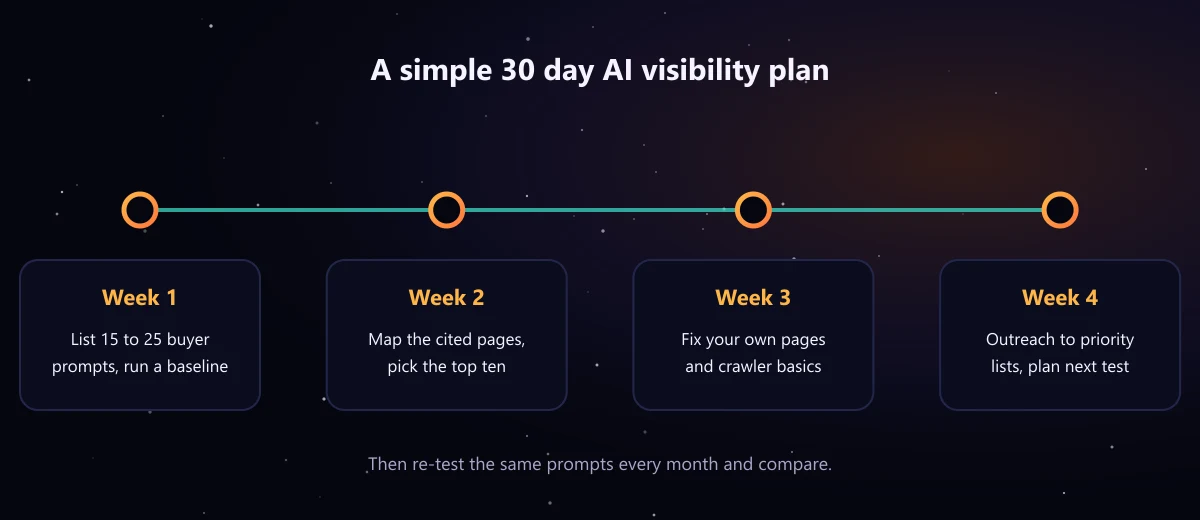
- Week 1: write 15 to 25 buyer prompts and run the baseline test in three engines.
- Week 2: map the cited pages and pick the ten that matter most.
- Week 3: fix your own pages (definition sentence, comparison pages, pricing, FAQ, schema) and the crawler basics.
- Week 4: start outreach to the priority lists and articles, then schedule the next monthly test.
If you would rather have this done for you, our generative engine optimization services cover the audit and placements on the pages AI engines already cite, with prices shown before you commit.