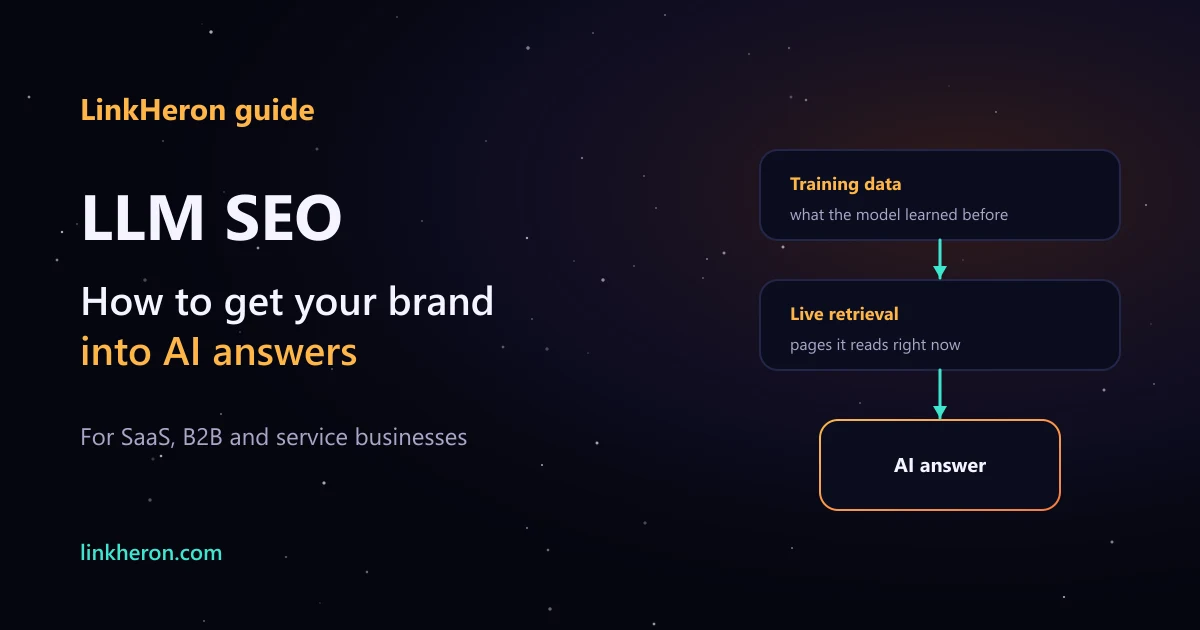
LLM SEO is the work of making large language model tools such as ChatGPT, Perplexity, Claude and Gemini understand, mention and recommend your brand when people ask about your category. It builds on normal SEO, but the goal shifts from ranking a page to being named, described correctly and cited inside the answer.
What is LLM SEO?
LLM SEO (large language model search engine optimization) means shaping what AI assistants know and retrieve about your business, so they include you, accurately, in answers to the questions your buyers ask. You will also see it called generative engine optimization (GEO), answer engine optimization (AEO) or AI SEO. The names differ, the job is the same.
How LLMs learn about your brand: two pathways
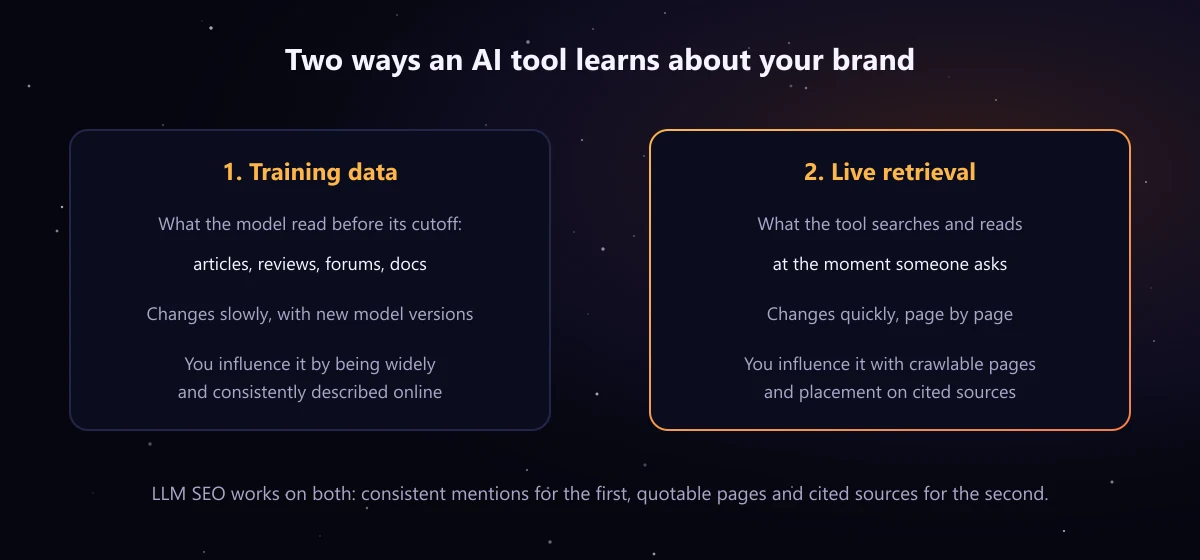
An AI tool can know about you in two different ways, and LLM SEO has to work on both:
- Training data. What the model read before its knowledge cutoff: articles, reviews, forums, documentation. This changes slowly, when new model versions ship. You influence it by being described widely and consistently across the web.
- Live retrieval. What the tool searches for and reads at the moment someone asks. This changes quickly, page by page. You influence it with pages that crawlers can reach and quote, and by appearing on the third party pages the tool tends to cite.
For a newer or smaller brand, live retrieval is where you can move fastest. A 2026 study of more than 100,000 AI answers (arXiv 2606.20065) found that about 78% of cited sources were corporate websites and that ranked "best of" lists were the most cited content format, at about 21% of citations. Both your own pages and the lists in your category matter.
LLM SEO vs traditional SEO
| Traditional SEO | LLM SEO | |
|---|---|---|
| Goal | Rank a page in the results | Be named and described correctly in the answer |
| Unit of success | A position and a click | A mention, a recommendation or a citation |
| What gets used | The whole page | Short passages and facts lifted from many pages |
| Off site signal | Links that pass authority | Links plus consistent mentions on sources the tool trusts |
| Measurement | Rankings, traffic, conversions | Share of answers, accuracy, AI referral traffic |
They overlap more than they differ. Pages that rank well are often the pages AI tools retrieve, so LLM SEO is an extension of good SEO, not a replacement.
How to do LLM SEO: five practical moves
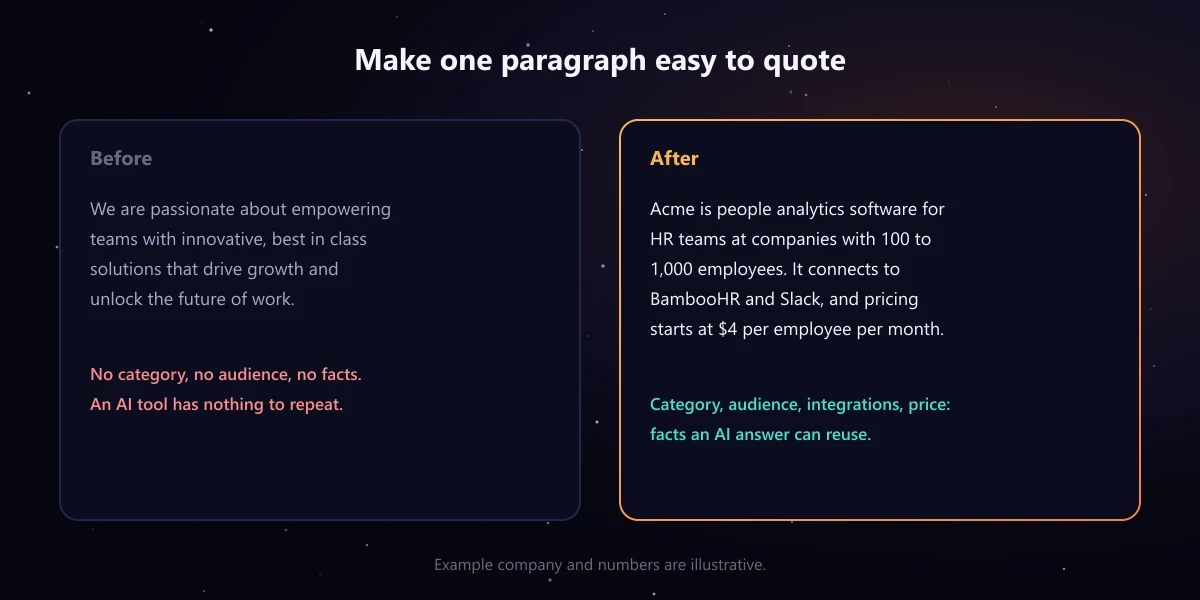
1. Write one paragraph an AI tool can quote
AI answers reuse short, factual passages. Marketing copy full of adjectives gives them nothing to repeat. On your homepage and key product or service pages, add a plain paragraph that states your category, who you serve, what you connect to or deliver, and how pricing works.
2. Keep a brand fact sheet and use it everywhere
Write down the facts you want every AI answer to get right: one sentence description, category, ideal customer, main use cases, integrations or service areas, pricing model, founding year and location. Use the same wording on your site, your LinkedIn and X profiles, directory listings such as G2, Capterra or Clutch, and partner pages. When sources agree, tools repeat you with confidence. When they disagree, answers get vague or wrong.
3. Answer the questions your buyers type into AI tools
Collect real questions from sales calls, support tickets and search autocomplete, then answer each one directly under a question style heading, in the first two sentences. Comparison pages, alternatives pages and honest pricing pages answer the questions that come right before a shortlist.
4. Get mentioned on the pages AI tools already cite
Ask the tools your buyers' questions, note which roundups, reviews and comparisons they cite, and work on being included there with an accurate entry. Choose sites with real readers: when we checked 107 SaaS and B2B blogs in Ahrefs, 13 had a Domain Rating of 40 or more but fewer than 500 monthly visitors, which is a poor place to be described. Our guide on how to improve brand visibility in AI search engines shows the full testing and source mapping process.
5. Make your pages easy to fetch
Let AI search crawlers such as OAI-SearchBot and PerplexityBot reach your site, keep important text in the HTML rather than loaded later by scripts, keep your sitemap accurate, and verify your site in Bing Webmaster Tools. An llms.txt file is an optional extra; our free llms.txt generator builds one from your sitemap in a few seconds.
LLM SEO for service businesses
Agencies, consultancies, IT services firms and other service businesses get recommended differently from software. AI tools look for evidence that you do the work, for whom, and where. A few things matter more for services:
- Service pages that name the outcome and the client type, for example "SOC 2 readiness for Series A SaaS companies", not just "compliance consulting".
- Case studies with specifics: the industry, the problem, what you did and the result, written so a single paragraph stands on its own.
- Reviews on the directories AI tools read, such as Clutch, G2 or Google Business Profile, with consistent service categories.
- Location and coverage stated plainly if you serve specific regions, because many service prompts include a place.
- Price ranges or how pricing works, since "how much does it cost" is one of the most common questions people ask AI tools about services.
What LLM SEO cannot do
Nobody can guarantee that ChatGPT or any other tool will recommend you, or put you into a model's training data on demand. Results build over weeks and months as tools refresh their sources. Be wary of anyone selling shortcuts such as fake reviews, forum spam or hidden text aimed at AI tools: they break platform rules and can damage how you are described.
If you want help with the source side, our LLM SEO services find the pages AI tools cite for your buyers' questions and get your brand accurately onto them, with prices shown before you approve anything.